Social security agreements in six Latin American countries

A social security agreement, also called a totalization agreement, lets you count years worked in two countries towards one pension. Of the six countries we cover, only Chile has one with the United States or the United Kingdom.

Checked November 2026

Chile

United StatesYes

In force since 1 December 2001

United KingdomContributions only

In force since 1 June 2015. Periods cannot be combined

Other bilateral agreements in force
  • Argentina
  • Australia
  • Austria
  • Belgium
  • Brazil
  • Canada and Quebec
  • Colombia
  • Czech Republic
  • Denmark
  • Ecuador
  • Finland
  • France
  • Germany
  • Luxembourg
  • Netherlands
  • Norway
  • Paraguay
  • Peru
  • Portugal
  • South Korea
  • Spain
  • Sweden
  • Switzerland
  • Uruguay
Multilateral

Ibero-American convention

Panama

United StatesNo
United KingdomNo
Other bilateral agreements in force

None found that combines contribution periods

An arrangement with Spain covers healthcare only.

Multilateral

Not applying the Ibero-American convention

Mexico

United StatesNo

Signed 29 June 2004 and never brought into force

United KingdomNo
Other bilateral agreements in force
  • Spain
  • Canada
Multilateral

None

Colombia

United StatesNo
United KingdomNo
Other bilateral agreements in force
  • Spain
  • Chile
  • Ecuador
  • Argentina
  • Uruguay
Multilateral

Ibero-American convention, applied since 1 August 2023

Peru

United StatesNo
United KingdomNo
Other bilateral agreements in force
  • Argentina
  • Canada
  • Chile
  • Ecuador
  • South Korea
  • Spain
  • Uruguay
Multilateral

Ibero-American convention, since 20 October 2016

Argentina

United StatesNo
United KingdomNo
Other bilateral agreements in force
  • Belgium
  • Chile
  • Colombia
  • Ecuador
  • France
  • Greece
  • Israel
  • Italy
  • Luxembourg
  • Peru
  • Portugal
  • Slovenia
  • South Korea
  • Spain

Canada is due in force on 1 December 2026. Switzerland is approved, with no start date.

Multilateral

MERCOSUR (Brazil, Paraguay, Uruguay) and the Ibero-American convention (adds Bolivia and El Salvador)

What an agreement does

  • Adds your periods together. If one country needs 20 years and you have 8 there and 14 in the partner country, the 22 years combined meet the test. Each country then pays a pension for the years worked there.
  • Stops double contributions. An employee posted abroad for a limited time stays in the home scheme and pays nothing in the host country.
  • Lets the pension be paid abroad without a reduction for living outside the country.

An agreement does not move money. Your contributions stay in the country where you paid them.

If you are from the United States

Chile is the only one of the six with a US totalization agreement, in force since 1 December 2001. The agreement with Mexico was signed in 2004 and never brought into force. Work in Panama, Colombia, Peru or Argentina does not count towards US Social Security, and you may owe contributions in both countries unless your employer keeps you on a US payroll.

If you are from the United Kingdom

The UK's convention with Chile, in force since 1 June 2015, covers contributions only. It keeps a posted worker in one scheme but does not combine UK and Chilean periods. The UK has no agreement with the other five. You can usually pay voluntary National Insurance to keep building a UK State Pension while you work abroad.

If you are from Canada or Spain

Canada has agreements with Chile, Mexico and Peru, and one with Argentina due in force on 1 December 2026. Spain has agreements with Chile, Mexico, Colombia, Peru and Argentina, and is party to the Ibero-American convention that links Chile, Colombia, Peru and Argentina.

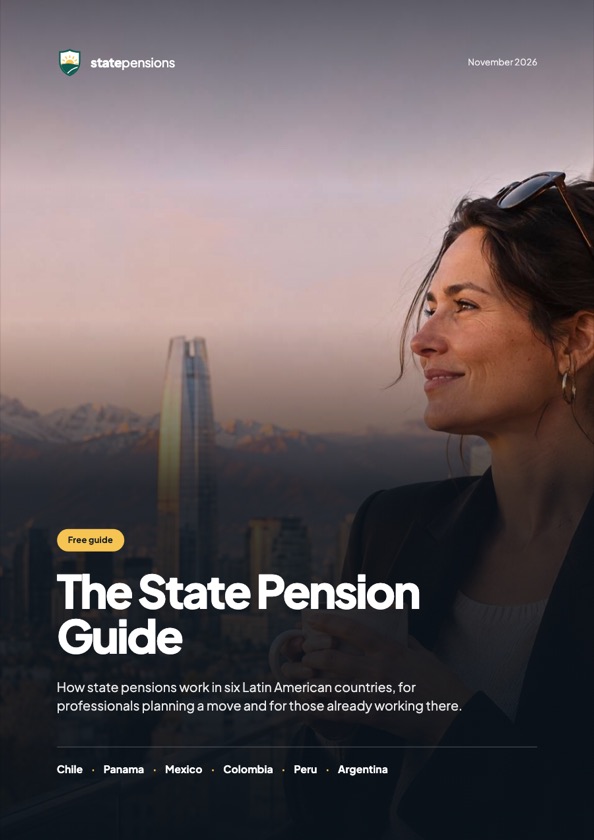
A man on a video call in his home office in Buenos Aires, a world map behind himCover of The State Pension Guide

Get the FREE State Pension Guide

One plain guide to the pension systems of Chile, Panama, Mexico, Colombia, Peru and Argentina: what you pay, when you can claim and what you can take with you if you leave.